Violet’s Parents’ Ban on Seeing Finch
All the Bright PlacesViolet’s Parents’ Ban on Seeing Finch turns the Markey parents’ fear for their daughter’s safety into a direct restriction on her relationship with Theodore Finch. The rule forbids both seeing Finch and driving around with him, and its consequences reach beyond the couple: Violet’s parents threaten to intervene in her schoolwork, Violet expects to lose their trust, and the two teenagers are left trying to preserve their closeness under parental scrutiny.
Cause and Terms of the Ban
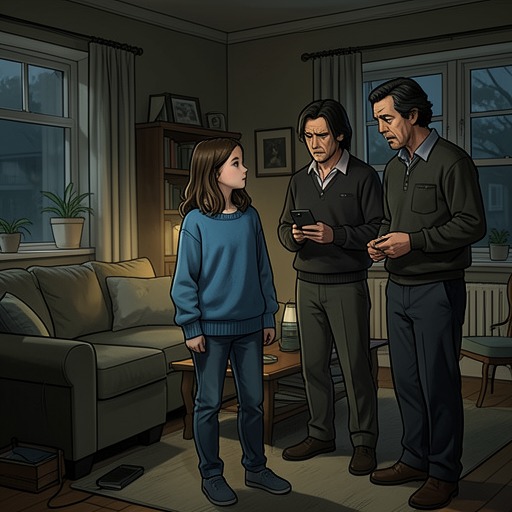
The confrontation grows out of Violet’s being late getting home after time with Finch. Her parents insist that they have tried to be reasonable, but explain that their concern is to keep her safe. Violet connects that concern to Eleanor Markey’s death, accusing them of wanting to keep her shut inside so nothing similar can happen to her. Her response makes clear that the rule is not experienced as an ordinary limit on a date; it touches the grief and fear already shaping her family’s life.
Her father makes the restriction explicit: Violet is not to see Finch or continue driving around with him. He also threatens to speak to her teacher on Monday if necessary, proposing that she write a report or complete another assignment to make up for the work. The ban therefore reaches from her private life into school, where her parents are prepared to replace the work she had been doing with an alternative. Her mother does not countermand him. Violet answers that they understand each other, then retreats into the phrase extenuating circumstances, suggesting that she recognizes the familiar pattern of her plans being altered by events she cannot control.
Immediate Consequences at Home
After the confrontation, Violet watches the street from her bedroom window, still imagining that Finch might return. She thinks that if he does, she will climb out of the window and tell him to drive as far and as fast as he can. The imagined escape stands against the parents’ stated purpose: they want to keep her safe by limiting movement, while Violet imagines movement itself as the way to get free. Finch does not appear. Hearing her parents’ voices downstairs, she concludes that they will never trust her again.
Finch, meanwhile, writes to apologize and asks whether Violet is all right. He says he wishes the night had gone differently but does not regret what came before. Violet’s reply is equally direct: she says that she is all right, asks whether Finch is all right, and confirms that she does not regret their relationship either, although she wishes she had been home on time. She also tells him that her parents do not want her seeing him anymore. The exchange separates regret about the circumstances from regret about the relationship: the lateness has consequences, but neither teenager treats their attachment as a mistake.
The Ban Enforced
The next morning, Finch goes to Violet’s home and rings the bell. Sheryl Markey answers but remains in the doorway rather than letting him in. Her apology and a shake of her head communicate that he cannot visit. From inside, James Markey asks whether the visitor is Finch; Sheryl does not answer him. She looks over Finch’s face and asks whether he is all right, a gesture Finch reads as concern mixed with the belief that he is different, strange, and untrustworthy. The scene makes the ban physical: the doorway becomes a boundary between Finch and the household, and Sheryl’s kind attention does not open it.
The restriction does not immediately end the relationship. At school, Violet and Finch see each other in U.S. Geography and kiss under stairwells or in dark corners. They spend the rest of the week meeting only at school, then go their separate ways in the afternoons and talk online at night. The contrast is stark: the parents have prohibited contact, yet the couple continues to find small, concealed intervals in which to be together. Finch’s kisses carry the fear that Violet might disappear, while the secrecy makes their closeness feel more intense to her.
Evasion and Continuing Pressure
Online, Finch asks whether anything has changed. Violet tells him that her parents’ position has not. She says they need time, but also explains that if Finch came to the house and she sneaked out or let him in, her parents really would lock her inside. The threat of that response narrows their options: the house is not a viable place to meet, and ordinary visits cannot continue without risking a harsher restriction.
For an hour, they trade increasingly elaborate ideas for seeing each other, including a fake alien abduction, setting off the citywide tornado alarm, and digging a tunnel between their sides of town. The absurdity gives their frustration a playful form, but none of the schemes changes the practical conditions of the ban. That night, Violet lies awake after ending the conversation. Her mind races as it used to before the previous spring, and she turns on the light to sketch ideas for Germ, including advice for asking a parent, book playlists, monthly soundtracks, and a section where readers could share unusual places. The ban thus coincides with Violet’s return to sustained creative activity; even while her freedom to see Finch is curtailed, she begins shaping a project around the places and experiences she wants to explore.
The available scenes leave the restriction in force: Violet’s parents have not changed their minds, Finch has been turned away at the door, and the couple relies on concealed school meetings and online conversation. The ban is therefore both a family rule and an ongoing pressure on the relationship. It does not make Violet stop caring for Finch; instead, it changes where and how that attachment can be expressed, while exposing the gap between her parents’ protective intentions and her experience of being controlled.